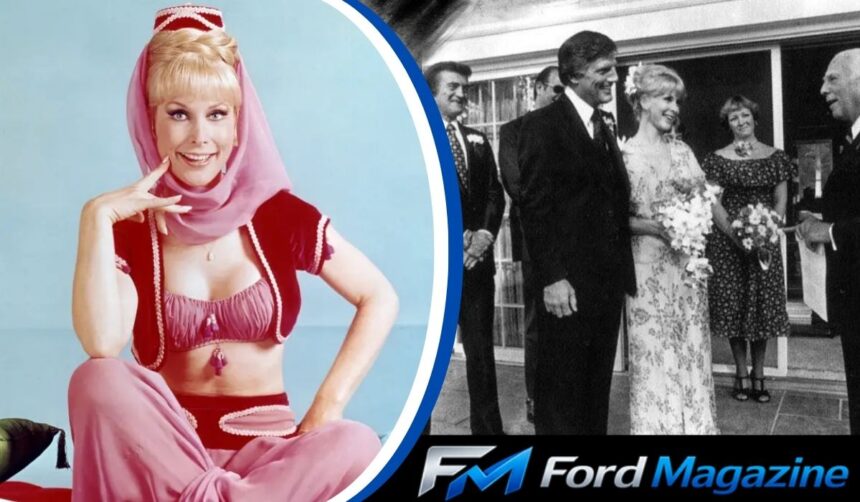
Charles Donald Fegert is primarily remembered by entertainment audiences as the second husband of Barbara Eden, the celebrated actress who became a television icon through I Dream of Jeannie. However, describing him only as a celebrity spouse leaves out an important part of his story. Long before his relationship with Eden attracted public attention, Fegert had established himself in Chicago’s competitive newspaper advertising industry. He held a senior position connected with the Chicago Sun-Times and built a professional reputation in sales, marketing, and media management. His marriage to Eden began during a transitional period in both of their lives, but the relationship eventually became troubled and ended after approximately five years. Because Fegert was not an actor or public entertainer, many details about his private background remain limited or inconsistently reported. What is reliably known presents the story of a successful newspaper executive whose personal life briefly became closely connected to Hollywood fame.
Quick Information About Charles Donald Fegert
| Detail | Information |
|---|---|
| Full name | Charles Donald Fegert |
| Common nickname | Chuck Fegert |
| Nationality | American |
| Known for | Being Barbara Eden’s second husband |
| Profession | Newspaper advertising and marketing executive |
| Main industry | Print media and advertising |
| Notable workplace | Chicago Sun-Times |
| Reported senior role | Advertising executive |
| Former spouse | Barbara Eden |
| Marriage year | 1977 |
| Divorce year | 1982 |
| Length of marriage | Approximately five years |
| Connection to Hollywood | Marriage to a prominent television actress |
| Public profile | Mainly professional before marrying Eden |
| Available information | Limited because he lived mostly outside entertainment |
Charles Donald Fegert’s Background
Unlike Barbara Eden, whose career was documented through interviews, television appearances, and film credits, Charles Donald Fegert lived much of his life outside the entertainment spotlight. He was associated with Chicago, where he developed his career and became active in the city’s newspaper business. Various biographical accounts describe him as an ambitious, confident, and socially skilled executive who understood how advertising supported the financial strength of a major newspaper. These qualities would have been particularly important during the period when newspapers competed intensely for readers, commercial clients, and local influence. Reliable public information about his exact birth date, childhood, parents, and education is scarce, so responsible biographies should avoid presenting uncertain internet claims as established facts. What stands out most clearly is that he built an independent professional identity before meeting Eden. His connection to a famous actress made him more recognizable nationally, but his original reputation was rooted in Chicago business circles rather than celebrity culture.
His Career in Newspaper Advertising

Fegert worked in newspaper advertising and reportedly rose to an executive position at the Chicago Sun-Times. Some accounts also connect his responsibilities with the Chicago Daily News, another significant publication in the city’s media history. Advertising executives were essential to newspaper operations because commercial revenue helped finance reporting, printing, circulation, and employee salaries. Fegert’s work likely involved building relationships with major businesses, directing advertising strategies, supervising sales personnel, and helping the publication remain commercially competitive. Reaching a senior position in this field required more than charm. It demanded an understanding of consumer behavior, negotiation, marketing trends, and the economic pressures facing print publications. Although his marriage later became the most frequently discussed part of his biography, his career demonstrates that he was already professionally successful. Contemporary summaries consistently identify him as a Chicago Sun-Times executive, while Barbara Eden’s public biographies confirm that she married the Chicago newspaper professional in 1977.
A Respected Figure in Chicago Media
During the height of Fegert’s career, Chicago had one of the most energetic newspaper markets in the United States. Major publications competed not only through journalism but also through circulation campaigns, promotional events, and advertising partnerships. An executive working in that environment needed to be persuasive, visible, and comfortable dealing with influential business leaders. Fegert was reportedly known for having a strong personality and an ability to communicate effectively in professional and social settings. His newspaper position would have given him access to corporate clients, community organizations, media personalities, and prominent figures around the city. This was a different kind of public world from Barbara Eden’s Hollywood environment, but it also depended heavily on image, networking, and personal confidence. The professional circles in which Fegert moved help explain how he could comfortably enter a relationship with an internationally recognized actress without being completely overwhelmed by her celebrity status.
How Charles Donald Fegert Met Barbara Eden
Barbara Eden met Charles Fegert after the end of her first marriage to actor Michael Ansara. Eden and Ansara had married in 1958 and divorced in 1974 after a long relationship that included professional achievements and serious personal difficulties. By the time Eden encountered Fegert, she was already famous for playing Jeannie in the NBC fantasy sitcom I Dream of Jeannie, which aired from 1965 to 1970. She was also continuing to work in television, films, stage productions, and live performances. According to accounts based on Eden’s recollections, she was emotionally lonely when Fegert entered her life. He appeared confident, attentive, and different from the Hollywood personalities she regularly met. Their relationship developed relatively quickly, and his courtship reportedly included romantic gestures and consistent attention. That early warmth gave Eden reason to believe she had found stability following the difficult conclusion of her first marriage.
Their Marriage in 1977
Charles Donald Fegert and Barbara Eden married in 1977, making him the actress’s second husband. Their union brought together two demanding professional worlds: Eden’s life as a traveling performer and screen actress, and Fegert’s responsibilities within Chicago’s newspaper industry. After their wedding, Eden spent considerable time in Chicago and adjusted to life away from the center of Hollywood. The relationship initially seemed to offer a fresh beginning. Fegert was accomplished in his own field, meaning he was not financially or professionally dependent on his wife’s celebrity. That independence may have been appealing to Eden, who had experienced fame for many years and understood the pressures it could place on personal relationships. Yet the couple also faced practical differences involving location, career schedules, lifestyle, and emotional expectations. Their marriage was later summarized by major profiles as lasting approximately five years, from 1977 until their divorce in 1982.
Life Between Chicago and Hollywood
The marriage required Eden to balance her professional commitments with a household connected to Chicago. During this period, she remained a recognizable television star and continued accepting important roles. In 1978, she appeared in the feature film Harper Valley PTA, inspired by the famous country song. The film’s success led to a television series that aired in the early 1980s. Therefore, Eden’s career remained active throughout much of her marriage to Fegert. Her work involved rehearsals, production schedules, publicity duties, and travel, while his career centered on newspaper advertising and business management. A marriage involving two independently successful people can provide mutual respect, but it can also create logistical pressure when neither partner can easily abandon professional obligations. Eden’s continuing visibility also meant that private difficulties had the potential to become public discussion. Fegert, meanwhile, had entered a level of national celebrity attention that was very different from being locally prominent in Chicago’s media community.
Problems Within the Relationship
Although the marriage began with affection and optimism, Eden later described it as deeply unhappy. Public accounts discussing her memoir and interviews report that Fegert’s behavior changed during the relationship and that substance misuse contributed to instability. Eden also described emotional distress and troubling treatment within the marriage. These details should be presented carefully because most of the widely available narrative comes from Eden’s personal account rather than extensive public statements from both individuals. Nevertheless, her recollections make clear that she eventually felt unsafe, unhappy, and unable to preserve the relationship. The contrast between the charming man she first met and the difficult conditions she later described became central to how she remembered the marriage. Her experience also demonstrates how a relationship that appears glamorous from outside can contain serious private struggles. Wealth, career success, and social standing did not prevent the couple from facing painful personal conflict.
Why Their Marriage Ended
By the early 1980s, the couple’s problems had reportedly become too severe to resolve. Eden ultimately chose to leave the marriage, and the divorce was completed in 1982. Some less authoritative sources give slightly different dates, but major profiles of Eden consistently identify 1977 as the year of marriage and 1982 as the year of divorce. The separation ended a union that had lasted about five years. Eden’s decision marked an important moment in her personal development because she had to remove herself from a relationship she later characterized as damaging. Divorce can be especially complicated for a public figure, as personal pain may be discussed in newspapers and entertainment coverage. For Fegert, the end of the marriage permanently connected his name with a difficult chapter in the actress’s life. However, it is still important to recognize that his entire identity cannot be reduced to the divorce, particularly when detailed records of his later private life are limited.
Barbara Eden’s Life After the Divorce
Following her separation from Fegert, Barbara Eden continued building a wide-ranging career that extended far beyond I Dream of Jeannie. She appeared in television productions, toured in stage shows, performed in musicals, and remained connected with generations of fans. In 1988, she received a star on the Hollywood Walk of Fame for her contribution to television. Eden later married real estate developer and architect Jon Eicholtz in 1991. Their enduring relationship presented a sharp contrast to the difficulties she associated with her second marriage. She also published the memoir Jeannie Out of the Bottle in 2011, discussing her career, family, marriages, and personal hardships. The book brought renewed attention to Fegert because Eden openly reflected on their relationship. Her willingness to discuss that period gave audiences a clearer understanding of why the marriage ended, while also showing how she rebuilt her emotional life and continued working after the divorce.
Fegert’s Life Outside the Spotlight
After the marriage ended, Charles Donald Fegert largely disappeared from national entertainment coverage. This is understandable because he had never pursued fame as an actor, musician, or television personality. His public relevance was primarily connected to his newspaper career and his years with Eden. Available online profiles frequently repeat claims about his family life, later career, and death, but many fail to provide dependable documentation. For that reason, details such as his precise birth year, number of children, later marriages, and date of death should not be stated with certainty unless supported by strong records. His limited public profile is also evidence that he returned to a much more private existence after the divorce. Unlike Eden, whose profession required interviews and public appearances, Fegert had no continuing reason to discuss the relationship in the entertainment press. As a result, modern readers mostly encounter him through Eden’s biography.
Public Interest in Charles Donald Fegert
Interest in Fegert continues because audiences remain curious about the personal lives of classic television stars. I Dream of Jeannie became a lasting part of American popular culture, and Barbara Eden’s portrayal of the playful genie made her one of television’s most recognizable performers. Fans who explore her life naturally encounter the three major marriages that shaped her personal history. Fegert occupies a particularly complicated place in that story because the relationship began romantically but ended under painful circumstances. Searches for his name often focus on his career, the way he met Eden, their wedding, and the reasons behind their divorce. However, informative coverage should separate verified information from speculation. The most dependable facts are that he was a Chicago newspaper advertising executive, married Eden in 1977, and divorced her in 1982. Claims extending far beyond those basic facts require greater caution.
Understanding His Place in Barbara Eden’s Story
Charles Donald Fegert represents a transitional chapter in Barbara Eden’s life. Their marriage occurred after the conclusion of her long relationship with Michael Ansara but before she found lasting companionship with Jon Eicholtz. During those five years, Eden was also redefining her career beyond the role that had made her famous. She was working to prove that she could lead new films, television programs, and stage productions rather than remaining permanently identified with Jeannie. Her relationship with Fegert existed alongside that professional reinvention. Although their marriage did not succeed, it influenced Eden’s understanding of emotional security, independence, and personal boundaries. From a biographical perspective, Fegert is significant not simply because he married a celebrity, but because the relationship became part of Eden’s larger story of resilience. She continued moving forward professionally and personally despite experiencing disappointment and distress.
Final Thoughts
Charles Donald Fegert was an American newspaper advertising executive whose name became widely recognized through his marriage to Barbara Eden. He had built a successful career in Chicago media before entering the actress’s life, reportedly reaching a senior position at the Chicago Sun-Times. Their relationship began during a vulnerable period for Eden and initially appeared to offer love and stability. They married in 1977, but the union gradually became troubled and ended in divorce in 1982. While Eden later spoke openly about her negative experiences, Fegert remained comparatively private, leaving many parts of his biography poorly documented. The most accurate understanding of him combines both sides of his public identity: an accomplished advertising professional and a significant but difficult figure in Barbara Eden’s personal history. His story also reminds readers that celebrity relationships are often more complicated than their public appearance suggests.
Frequently Asked Questions
Who was Charles Donald Fegert?
Charles Donald Fegert was an American newspaper advertising executive associated with the Chicago Sun-Times. He became nationally known after marrying I Dream of Jeannie actress Barbara Eden, although he had already developed a successful professional career in Chicago media.
When did he marry Barbara Eden?
Fegert married Barbara Eden in 1977, several years after her divorce from her first husband, actor Michael Ansara. Their marriage lasted approximately five years before ending in 1982.
What did Charles Fegert do for a living?
He worked in newspaper advertising, sales, marketing, and management. He reportedly held a senior executive role at the Chicago Sun-Times, where his responsibilities would have involved commercial strategy, advertising relationships, and revenue development.
Why did Barbara Eden divorce him?
Eden later described the marriage as unhealthy and emotionally difficult. Accounts based on her recollections state that substance misuse and troubling behavior contributed to the breakdown of the relationship, leading her to leave and complete the divorce in 1982.
Did Charles Fegert work in Hollywood?
No, Fegert was not an actor, director, or Hollywood producer. His career was based primarily in Chicago’s newspaper industry, and his connection to the entertainment world came through his marriage to Barbara Eden.